Old Tjikko – the Oldest Tree in the World (9,550 Years Old)
The oldest individual clonal tree in the world is believed to be 9,550 years old (carbon-dated)! This Norway Spruce is located on the Fulufjället Mountain of Dalarna province in Sweden and was discovered by a professor of Physical Geography, Leif Kullman. The tree has been nicknamed "Old Tjikko" after his dog.
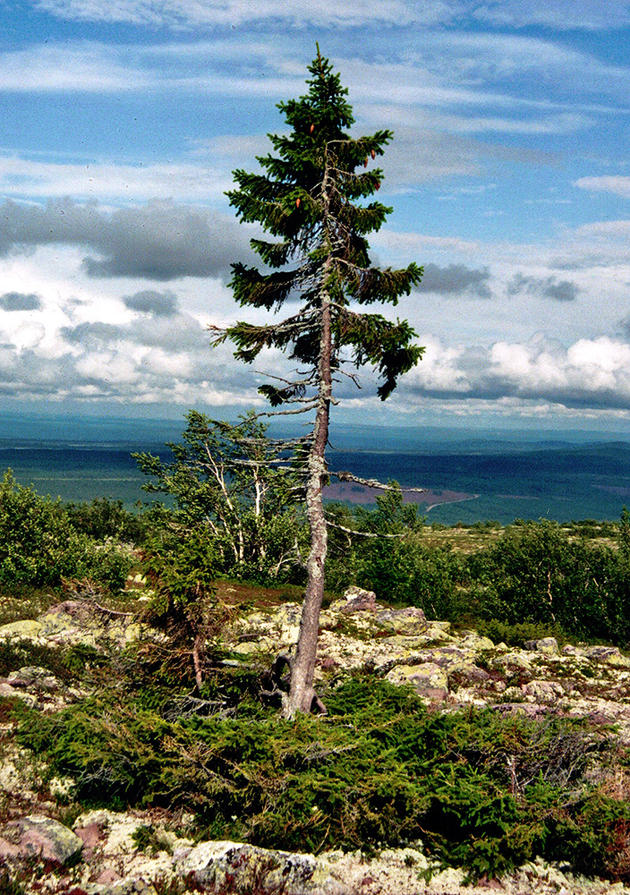
The Old Tjikko is is currently the oldest single-clonal tree in the world at 9,550 years old.
At first sight, this 5 meter (16 feet) tall tree might not strike you as the oldest known living organism, but don't let its size fool you! Over thousands of years this fella has successfully adapted to every climate change that has effected the area in which it resides.
It's believed that the reason why this tree has survived for so long is due to two processes:vegetative cloning and layering. During vegetative cloning, the tree trunk can die every few hundred years (~600 in this case), but the root system can live on for thousands of years. Layering occurs when one of the branches touches the ground and eventually "turns into a root".
Scientists have also located several other trees in the area, all dating to be 8,000+ years old – truly stunning!
Old Tjikko is located on the Fulufjället Mountain of Dalarna province in Sweden
Old Tjikko is a 9,550 year old Norway Spruce tree, located on Fulufjället Mountain of Dalarna province in Sweden. Old Tjikko is the world's oldest living individual clonal tree, however, there are many examples of much older clonal colonies (multiple trees connected by a common root system), such as "Pando", estimated to be over 80,000 years old.
The age of the tree was determined by carbon-14 dating of the root system, which found roots dating back to 375, 5,660, 9,000, and 9,550 years. The trunk itself is estimated to be only a few hundred years old, but the tree as a whole may have survived for much longer due to a process known as layering (when a branch comes in contact with the ground, it sprouts a new root), or vegetative cloning (when the trunk dies but the root system is still alive, it may sprout a new trunk).
Carbon dating is not accurate enough to pin down the exact year the tree sprouted from seed, but given the estimated age the tree is supposed to have sprouted around 7550 BCE. For comparison, the invention of writing (and thus, the beginning of recorded history) did not occur until around 4000 BCE. Researchers have found a cluster of around 20 spruce trees in the same area, all over 8,000 years old.
For thousands of years, Old Tjikko appeared in a stunted shrub formation (also known as a krummholz formation) due to the harsh extremes of the environment in which it lives. During the warming of the last century, the tree has sprouted into a normal tree formation and stands now 5 metres (16 feet) tall. The man who discovered the tree, Leif Kullman (Professor of Physical Geography at Umeå University), has attributed this growth spurt to global warming, and given the tree its nickname "Old Tjikko" after his late dog.
Previous researchers considered the Norway spruce species to be a relative newcomer to Sweden, with theories postulating the tree migrated into the area around 2,000 years ago. Trees much older than 10,000 years would be practically impossible in Sweden, because until around 11,000 years ago the area was in the grip of a world-wide ice age. Nature conservancy authorities are considering putting a fence around the tree to protect it from possible vandals or trophy hunters.


Geen opmerkingen:
Een reactie posten